Periodontal Plastic Surgery
Papilla Reconstruction
The small triangle of gum between adjacent teeth — the interdental papilla — is essential to a healthy, youthful smile. When it is lost, dark gaps known as “black triangles” can appear, affecting appearance, speech, and food retention.
Papilla reconstruction uses advanced microsurgical and regenerative techniques to restore this delicate tissue whenever clinically appropriate, rebuilding natural soft-tissue contours while supporting healthier periodontal architecture and long-term stability.
It is also the most difficult soft-tissue target in periodontal surgery, and honesty about that is more useful than optimism. The papilla is a small wedge of tissue with a blood supply from only two sides and no bone directly beneath its tip. It exists because the bone between the two teeth sits close enough to support it — and it fills the space to the contact point between them almost entirely as a function of that distance.
That relationship is well documented and it governs what surgery can achieve. Where the bone crest sits close beneath the contact point, tissue fills the space and no triangle appears. As the distance grows, the papilla becomes progressively less able to reach, and beyond a certain point it cannot. Grafting soft tissue into a space with no bone to support it does not produce a lasting papilla.
The practical consequence is that the most effective solutions are frequently not surgical. Lengthening the contact point between the teeth with bonding, reshaping them orthodontically, or altering the crown contour closes the gap from above rather than trying to build tissue from below — and for many patients that is the honest recommendation.
Who it’s for
- Dark black triangle gaps between the teeth, particularly in the smile zone
- Lost or blunted gum tissue between teeth after periodontal treatment
- Food packing into open interdental spaces after every meal
- Speech effects — air escaping between the front teeth
- Papilla loss adjacent to a dental implant or a crown margin
- Patients wanting an honest assessment of what is and isn’t achievable
What to expect
- 1
Measurement & assessment
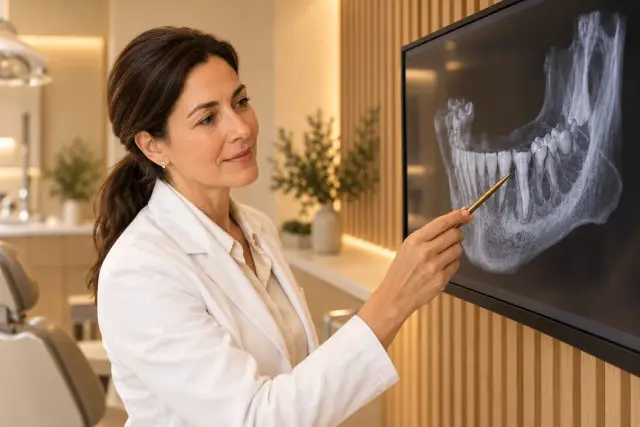
The distance from the bone crest to the contact point between the teeth is measured. This single relationship largely predicts whether tissue can fill the space.
- 2
Identifying the cause
Periodontal bone loss, recession, triangular tooth shape, divergent roots, or an over-contoured crown — the cause determines whether surgery or a restorative approach is appropriate.
- 3
Considering non-surgical options first
Where the contact point can be lengthened with bonding, orthodontics, or a modified crown shape, that is usually more predictable than surgery and we’ll say so.
- 4
The procedure
Where surgery is indicated, microsurgical technique — and regenerative materials or a connective tissue graft when appropriate — is used to rebuild the interdental tissue.
- 5
Protected healing
The area is left entirely undisturbed. Papillary tissue is fragile and the early weeks determine whether the gain holds.
- 6
Review
Results are assessed after the tissue has matured, and combined restorative refinement is planned if further closure is wanted.
Recovery & aftercare
Recovery is generally mild, with tenderness for a few days managed by simple aftercare and over-the-counter pain relief. The surgery itself is small; the demands are on the healing rather than the patient.
The site must not be disturbed at all — no brushing across it, no flossing between the treated teeth, no interdental brushes until we clear you. This is stricter than for most gum surgery, because the tissue being rebuilt has the least mechanical resilience of any in the mouth.
Because papilla tissue is delicate, results mature gradually over months and are reviewed at follow-up. Some rebound of the initial gain is common, so the outcome is judged late rather than early.
Common questions
- What causes black triangles?
- Loss of the gum between the teeth, most often from periodontal bone loss or recession. Naturally triangular tooth shape, roots that diverge, and previous orthodontic movement all contribute — and gaps sometimes appear after successful gum treatment simply because swollen tissue has shrunk back to a healthy volume.
- Can the papilla always be rebuilt?
- No, and it’s the least predictable procedure in periodontal plastic surgery. It depends chiefly on how far the bone crest sits below the contact point between the teeth. Close, and tissue fills the space readily. Far, and there is nothing supporting the tissue at its tip — no graft compensates for absent bone.
- Is there a non-surgical option?
- Frequently, and it’s often the better answer. Adding composite bonding to lengthen the contact point between the teeth, reshaping them, adjusting a crown contour, or closing the space orthodontically all address the gap from above. These are more predictable than surgery and we’d rather recommend them where they fit.
- Why did black triangles appear after my gum treatment?
- Because inflamed gum is swollen gum. Treating the infection lets that swelling resolve, and the tissue settles to its true position — revealing spaces that the swelling had been filling. The disease created the bone loss; the treatment simply made it visible. It is not a complication of the treatment.
- Will fillers or injectables work?
- Injectable hyaluronic acid has been used for small papillary deficiencies with some reported success, and is minimally invasive. The effect is temporary and requires repeating, and it works best for small gaps with reasonable bone support — the same cases that respond best to everything else.
- How much improvement can I realistically expect?
- Partial improvement in favorable cases, and we’d rather set that expectation before surgery than after. Complete restoration of a lost papilla is rarely achieved. Where a case is unfavorable we’ll tell you so and discuss restorative alternatives rather than proceeding with something unlikely to work.
- Do black triangles cause any actual harm?
- They aren’t harmful in themselves, but they trap food, are awkward to clean, and can make the exposed root surfaces more prone to decay. The most common motivation for treatment is appearance, with food packing a close second.
- Can this be done around a dental implant?
- It’s harder still. Papilla between an implant and a natural tooth depends on the bone level of the neighboring tooth, and papilla between two adjacent implants is notoriously difficult to maintain — which is why implant positions in the smile zone are planned with this in mind from the outset.
Talk to a specialist about papilla reconstruction
Whether you’re a patient considering treatment or a dentist referring a case, we’ll evaluate, plan, and coordinate care from diagnosis through follow-up.
Sources
This information is provided for educational purposes and is not a substitute for a professional evaluation. Diagnosis and treatment should always be determined by a qualified dental professional based on your individual condition.