

Dental Implant Dentistry
Ridge Augmentation
What Is Ridge Augmentation?
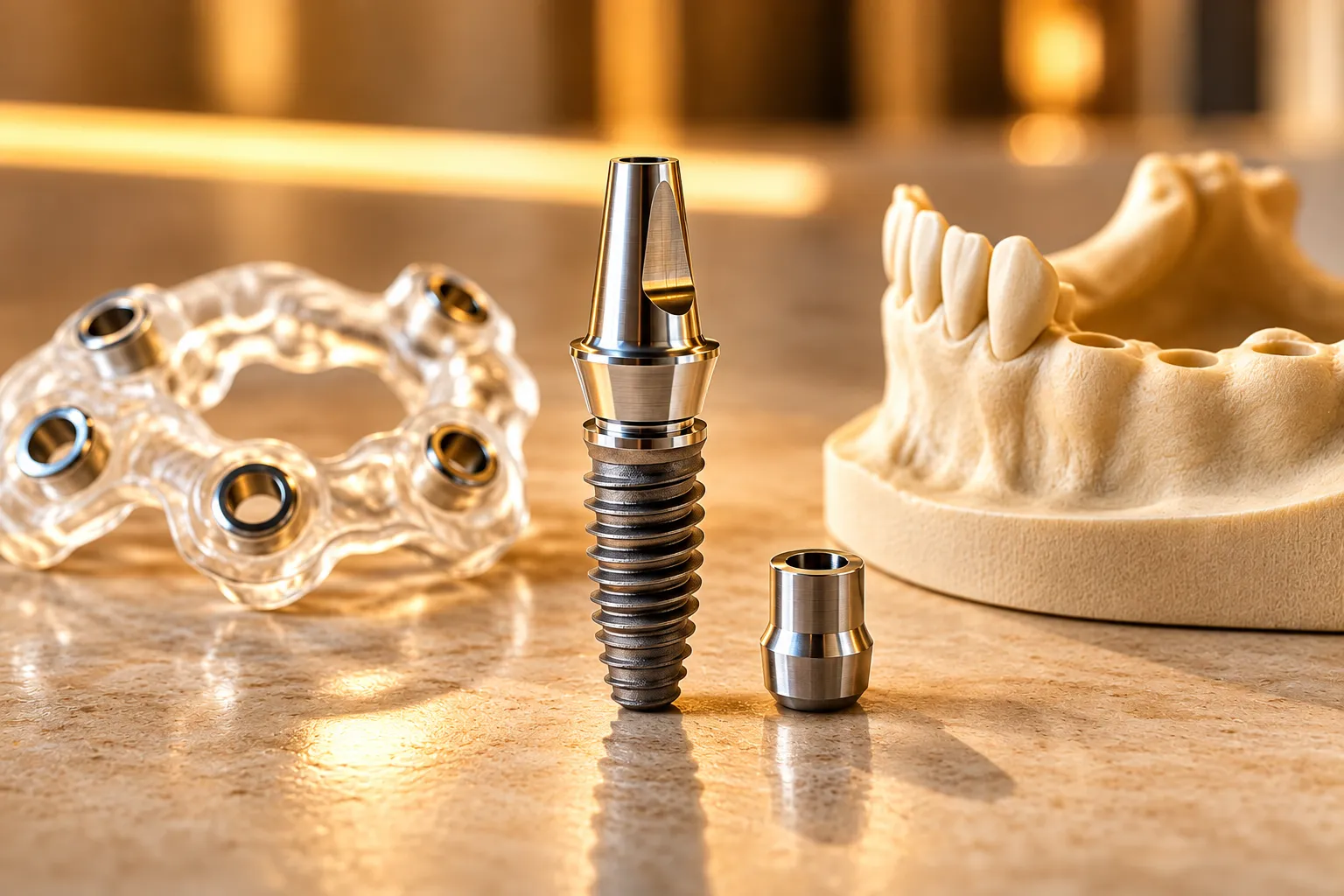
Ridge augmentation is a specialized bone-grafting procedure that rebuilds the natural shape, width, and height of the jawbone after tooth loss. It is often needed when bone has resorbed significantly, making implant placement difficult or compromising the esthetic result.
The alveolar ridge is the horseshoe of bone that held your teeth. It exists because teeth stimulate it — so when a tooth is lost and that stimulation stops, the ridge begins to remodel and shrink. The change is fastest in the first year and continues slowly for the rest of your life. Left long enough, a ridge that was once broad and rounded becomes a narrow, knife-edged crest with a visible dip in the gum above it.
That matters for two reasons. An implant needs bone on all sides to be stable, so a ridge that has narrowed below the width of the implant simply cannot hold one. And even where an implant would technically fit, placing it into a collapsed ridge puts the crown in the wrong position — it emerges too far back or too high, and the result looks and cleans nothing like a natural tooth.
Ridge augmentation rebuilds that lost architecture before the implant goes in. Graft material is placed to restore the missing dimension, held in position and protected while your own body converts it into living bone. The aim is not simply to create enough bone for an implant to survive in, but to recreate the ridge shape that lets the finished tooth sit where it belongs.
Types of ridge augmentation
The direction and severity of the bone loss determine the technique — and the techniques are often combined within a single case.
Horizontal augmentation
Rebuilds a ridge that has become too narrow from front to back. The most common form of ridge augmentation, and the more predictable of the two directions.
Vertical augmentation
Rebuilds lost ridge height. Technically more demanding and less forgiving than adding width, so it is planned carefully and reserved for cases where it is genuinely needed.
Block grafting
A solid block of bone is secured to the deficient ridge with fixation screws — used for larger defects where particulate graft alone would not hold its shape.
Ridge splitting & expansion
A narrow ridge is carefully split and expanded outward, with graft placed into the space created. Suitable for specific anatomy, and can sometimes allow the implant to be placed at the same visit.
Who it’s for
- A narrow, thin, or knife-edged ridge that can’t accommodate an implant
- A visible dip or collapse in the ridge where a tooth used to be
- Teeth missing for years, with significant resorption already present
- Bone lost to advanced periodontal disease, infection, or trauma
- Front-tooth sites where ridge contour drives the esthetic result
- Sites where an implant was declined elsewhere for insufficient bone
- Patients wanting a fixed implant rather than a removable partial denture
What to expect
- 1
Assessment & 3D imaging
CBCT imaging measures the ridge in three dimensions and quantifies exactly how much width and height are missing relative to the implant that needs to go there.
- 2
Choosing the technique
The defect determines the approach — a contained gap may need only particulate graft and a membrane, while a severely narrowed ridge may call for a block graft or ridge splitting.
- 3
The grafting procedure
Under local anesthesia the ridge is accessed, the graft material is placed and shaped to the intended contour, and a barrier membrane is secured over it where needed to keep gum tissue out of the space.
- 4
Closure
The gum is closed over the graft, usually without tension, so the site heals covered and protected. Sutures are typically removed after a week or two.
- 5
Bone maturation
Over the following months your body remodels the graft into your own living bone. Larger reconstructions take longer than small ones.
- 6
Re-imaging & implant placement
A follow-up scan confirms the rebuilt volume before implants are placed into the restored ridge — sometimes with a small additional graft at the same visit.
Recovery & aftercare
Mild swelling, soreness, and sometimes bruising are normal in the first several days — usually settling within a week or two and managed with over-the-counter pain relief and cold compresses. Swelling after a larger reconstruction is more noticeable than after a small graft, and typically peaks around the second or third day before improving.
The single most important instruction is to leave the site alone. You’ll be asked not to pull the lip up to look at it, not to brush directly over the graft until told otherwise, and to avoid anything that puts pressure on the area — including chewing on that side and, if you wear a denture or partial over the site, wearing it before we’ve adjusted or relieved it.
Healing time before implants can be placed depends on how much bone had to be rebuilt and is confirmed at follow-up rather than fixed in advance. Small augmentations mature faster than block or vertical reconstructions, and we re-image before committing to the implant date.
Common questions
- What’s the difference between ridge augmentation and socket preservation?
- Timing, mostly. Socket preservation is done at the moment a tooth is removed, to stop the ridge from collapsing in the first place. Ridge augmentation is done later, to rebuild a ridge that has already collapsed. Preserving is simpler and more predictable than rebuilding, which is why we recommend grafting at extraction whenever an implant is a possibility.
- Is ridge augmentation the same as a sinus lift?
- No, though both add bone for implants. A sinus lift adds bone height in the upper back jaw by lifting the sinus floor. Ridge augmentation rebuilds the width or height of the ridge crest itself, and can be done anywhere in either jaw. Some upper back cases need both.
- Where does the graft material come from?
- It depends on the defect. Options include your own bone harvested from elsewhere in the jaw, processed donor bone from a licensed tissue bank, bone mineral of animal origin, and fully synthetic materials — often in combination. Each behaves differently in how fast it turns over, and the choice is matched to the site rather than applied uniformly.
- How long before I can have the implant?
- Several months in most cases, though it varies considerably with the size of the graft. A small width correction matures faster than a large vertical reconstruction. We confirm readiness with a scan rather than by the calendar, because placing an implant into an immature graft undermines the whole point of doing it.
- Can I wear my denture or partial while the graft heals?
- Not immediately, and not unmodified. Pressure from a denture pressing down on a healing graft is one of the more common causes of graft failure. If you depend on an appliance, we adjust or reline it so it no longer loads the site, and we’ll tell you when it’s safe to wear it again.
- What happens if I skip the graft and just use a narrower implant?
- Sometimes a narrow implant is a legitimate option, and we’ll say so when it is. But forcing a smaller implant into a deficient ridge to avoid grafting has real costs — less surface area for support, thin or absent bone on the outer surface, and a crown that emerges in the wrong place. It’s a trade-off worth making deliberately, not by default.
- Does ridge augmentation always work?
- It’s a well-established and generally predictable procedure, but no graft is guaranteed. Smoking, uncontrolled diabetes, pressure on the site during healing, and infection all reduce success. Horizontal (width) augmentation is more predictable than vertical (height) augmentation, and we’ll be direct with you about which category your case falls into.
Want a second opinion first?
If you’ve been quoted implant, bone-grafting, or sinus-lift treatment and want to be sure it’s the right plan, a specialist second opinion is a low-cost, no-pressure way to confirm your options before you commit.
Request a second opinionTalk to a specialist about ridge augmentation
Whether you’re a patient considering treatment or a dentist referring a case, we’ll evaluate, plan, and coordinate care from diagnosis through follow-up.
Sources
This information is provided for educational purposes and is not a substitute for a professional evaluation. Diagnosis and treatment should always be determined by a qualified dental professional based on your individual condition.