
Dental Implant Dentistry
Guided Bone Regeneration
What Is Guided Bone Regeneration?
Guided bone regeneration (GBR) is a grafting technique that rebuilds bone at an implant site by controlling which tissue is allowed to fill the healing space. Graft material is placed into the deficient area and covered with a barrier membrane, and that membrane is what makes the technique work.
The reason a barrier is needed comes down to speed. When a bone defect heals, several tissues compete to occupy the space, and gum tissue grows into it far faster than bone forms. Left to itself, a defect fills with soft tissue and the bone you wanted never has room to develop. The membrane physically excludes the faster tissue and holds the space open, so the slower-forming bone can occupy it instead — the same principle as guided tissue regeneration around natural teeth.
GBR is the workhorse technique for localized bone deficiencies: a thin or missing patch of bone over the shoulder of an implant, a small gap between the implant and the socket wall, a modest dip in the ridge. It is frequently performed at the same appointment as the implant itself.
For larger reconstructions the same principle applies but the staging changes — bone is rebuilt first, allowed to mature, and the implant placed afterward. Which path applies to you depends on the size of the defect and whether the implant can be made stable in your existing bone at the time of surgery.
Who it’s for
- Localized bone defects at or around a planned implant
- A thin or missing outer bone wall over part of an implant
- Gaps between an immediately placed implant and the socket wall
- A small ridge deficiency correctable during implant surgery
- Bone defects found unexpectedly once the site is opened
- Rebuilding bone lost around a treated implant during peri-implantitis surgery
What to expect
- 1
Assessment & 3D imaging
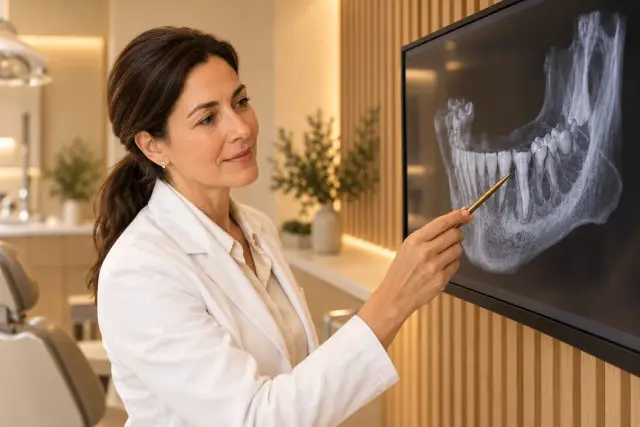
CBCT imaging defines the size, shape, and walls of the bone defect — a defect with more surrounding bone walls regenerates more predictably than one with fewer.
- 2
Deciding the staging
If the implant can be placed stably in existing bone, GBR is done at the same visit. If it can’t, the bone is rebuilt first and the implant follows once it has matured.
- 3
Site preparation
The area is accessed and cleaned, and the surface of the existing bone is prepared so blood vessels can reach the graft from below.
- 4
Graft & membrane
Graft material fills the defect and a barrier membrane is placed over it, secured with tacks or the implant cover screw where stability requires it.
- 5
Tension-free closure
The gum is released and closed fully over the membrane. Keeping the membrane covered is the single biggest factor in whether the regeneration succeeds.
- 6
Protected healing & placement
New bone forms beneath the membrane over the following months. Where GBR was staged ahead, the implant is placed once the site has matured.
Recovery & aftercare
Mild swelling and soreness for a few days are typical and managed with over-the-counter pain relief. Swelling is usually more noticeable when the gum has had to be released to achieve full closure over the membrane.
You’ll receive specific instructions to protect the membrane: no brushing directly over the site until cleared, no pulling the lip out to inspect it, no pressure from a denture or partial, and no smoking. Membrane exposure through the gum is the most common complication of GBR, and most of the things that cause it are within your control.
When GBR is done ahead of implant placement, the bone matures over several months and the timing is confirmed at follow-up with imaging. When it’s done alongside the implant, it heals on the implant’s own timetable and adds no extra stage to your treatment.
Common questions
- How is guided bone regeneration different from an ordinary bone graft?
- The membrane. A graft on its own supplies the scaffold; GBR adds a barrier over it that excludes gum tissue from the healing space. Without that barrier, soft tissue — which grows much faster than bone — invades the defect and occupies the volume you were trying to rebuild.
- What is the membrane made of, and does it have to come out?
- It depends which type is used. Resorbable membranes, usually collagen-based, dissolve on their own and need no second procedure. Non-resorbable membranes hold their shape more rigidly and are better suited to larger defects, but must be removed at a later appointment. The choice follows the defect.
- Can it be done at the same time as the implant?
- Often, yes. Smaller defects are routinely treated with GBR during implant placement, which avoids adding a separate surgical stage. The deciding factor is whether the implant can be made stable in your existing bone — if it can’t, the bone is rebuilt first.
- What happens if the membrane becomes exposed?
- It’s the most common complication and doesn’t automatically mean failure. A small late exposure of a resorbable membrane often heals with careful cleaning and monitoring. An early or large exposure risks contamination of the graft and may reduce how much bone forms. This is why the closure and aftercare instructions are emphasized so heavily.
- How much bone can guided bone regeneration rebuild?
- GBR is best suited to localized defects rather than large-scale reconstruction. It reliably rebuilds contained defects with surrounding bone walls to support the graft; extensive vertical deficiencies are less predictable and may call for block grafting or a different approach entirely.
- Is GBR used for anything other than implants?
- Yes. The same barrier principle is used to regenerate bone lost around implants affected by peri-implantitis, and the closely related technique of guided tissue regeneration is used to rebuild support around natural teeth damaged by periodontal disease.
- Why does smoking matter so much for this procedure?
- Smoking reduces blood flow to the healing tissues and impairs the soft-tissue closure that keeps the membrane covered. Regeneration depends on both. It is consistently one of the strongest risk factors for GBR failure, and stopping — even temporarily around the surgery — measurably improves the odds.
Want a second opinion first?
If you’ve been quoted implant, bone-grafting, or sinus-lift treatment and want to be sure it’s the right plan, a specialist second opinion is a low-cost, no-pressure way to confirm your options before you commit.
Request a second opinionTalk to a specialist about guided bone regeneration
Whether you’re a patient considering treatment or a dentist referring a case, we’ll evaluate, plan, and coordinate care from diagnosis through follow-up.
Sources
This information is provided for educational purposes and is not a substitute for a professional evaluation. Diagnosis and treatment should always be determined by a qualified dental professional based on your individual condition.