
Dental Implant Dentistry
Peri‑Implantitis Treatment
What Is Peri‑Implantitis?
Peri-implantitis is inflammation of the tissues around a dental implant that has progressed to loss of the supporting bone. It usually begins as peri-implant mucositis — redness, swelling, or bleeding of the gum around the implant with no bone loss yet — and, if left untreated, advances to destroy the bone that holds the implant in place.
It’s driven mainly by bacterial plaque building up around the implant, and the risk is higher for patients with a history of gum disease, smokers, and implants that are difficult to clean. Because the disease is often painless until it is advanced, it is frequently caught late — which is why specialist evaluation matters as soon as bleeding, swelling, or a loose-feeling restoration appears.
Who it’s for
- Bleeding, redness, or swelling of the gum around an implant
- Pus, a bad taste, or an implant that feels loose
- Bone loss around an implant seen on an X-ray or CBCT
- A history of gum disease or a previous implant complication
What to expect
- 1
Diagnosis & 3D imaging
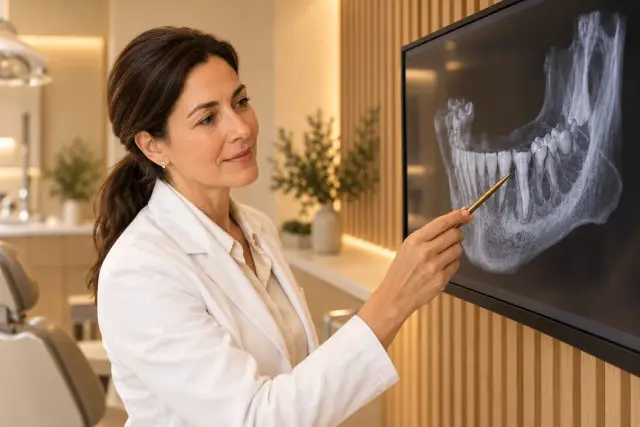
We measure the tissues around the implant and use CBCT imaging to map exactly how much bone has been lost and the shape of the defect.
- 2
Infection control
The implant surface is thoroughly decontaminated and inflammation is brought under control — sometimes non-surgically first for earlier cases.
- 3
Surgical access & debridement
When bone loss is established, the area is opened to clean the implant surface and remove diseased tissue that can’t be reached otherwise.
- 4
Regeneration where possible
Suitable bone defects are grafted — often with a barrier membrane — to rebuild support around the implant.
- 5
Ongoing maintenance
A tailored maintenance schedule protects the result and catches any recurrence early.
Recovery & aftercare
Mild swelling and soreness for a few days after surgical treatment are typical and managed with over-the-counter pain relief; you’ll receive specific home-care instructions to protect the healing site.
Peri-implantitis is a chronic condition, so results are protected by consistent maintenance and good home care. We coordinate your maintenance interval with your general dentist or hygienist.
Common questions
- Can an implant with peri-implantitis be saved?
- Often, yes — especially when it’s caught early. Controlling the infection, decontaminating the implant surface, and regenerating lost bone can stabilize many implants. The chance of saving it depends on how much bone has been lost, which we assess with imaging.
- How is peri-implantitis different from gum disease?
- They’re closely related — both are inflammation driven by bacteria — but peri-implantitis affects the tissue and bone around an implant rather than a natural tooth. Implants lack some of the protective attachment natural teeth have, so peri-implant bone loss can progress differently and needs implant-specific care.
- Is peri-implantitis painful?
- Frequently it isn’t, particularly in the early stages — which is what makes it dangerous. Bleeding when brushing, swelling, or a change in how the implant feels can be the only signs, so any of these warrant prompt evaluation.
- What happens if it’s left untreated?
- The supporting bone continues to be lost, the implant loosens, and it can eventually fail and need to be removed. Early treatment gives the best chance of keeping the implant and avoiding more complex reconstruction later.
- What causes peri-implantitis in the first place?
- Bacterial plaque accumulating around the implant is the driver. The risk is substantially higher for patients with a history of periodontal disease, for smokers, where the restoration is difficult to clean around or beneath, where excess cement was left at the margin, and where there is little firm gum tissue around the implant.
- Why can’t it just be cleaned like a gum pocket?
- Because implant surfaces are microscopically roughened to encourage bone attachment, and that same texture makes bacterial biofilm far harder to remove than from a smooth root. Non-surgical cleaning is worth attempting early, but established defects usually need surgical access to decontaminate the surface properly.
- Will the bone I’ve lost grow back?
- Sometimes partially. Contained, well-shaped defects with bone walls around them can be grafted with reasonable success. Broad, shallow defects with no containment generally cannot be regenerated — there the realistic aim is to arrest the disease and keep the implant stable rather than rebuild.
- How is it different from peri-implant mucositis?
- Mucositis is inflammation of the gum around the implant with no bone loss, and it is reversible with thorough cleaning and better home care. Peri-implantitis means bone has already been lost, and that loss doesn’t reverse on its own. Catching it at the mucositis stage is the entire purpose of implant maintenance.
- Will I need the implant removed?
- Often not, particularly when it’s caught reasonably early. Removal becomes the right call when too little bone remains for the implant to be stable, when the infection can’t be controlled, or when the implant’s position was compromised to begin with. We’ll be direct about which situation applies.
- If I lose this implant, can I have another?
- Usually yes. After removal the site is cleaned and, where needed, grafted to rebuild support, then a replacement is planned around whatever caused the original failure. Addressing that cause is what stops the same thing happening again.
- Does smoking affect the outcome?
- Significantly. Smoking is one of the strongest risk factors both for developing peri-implantitis and for treatment failing to hold. It reduces blood flow to exactly the tissues that treatment relies on. Reducing or stopping meaningfully improves the odds, and we’d rather say so than not.
Want a second opinion first?
If you’ve been quoted implant, bone-grafting, or sinus-lift treatment and want to be sure it’s the right plan, a specialist second opinion is a low-cost, no-pressure way to confirm your options before you commit.
Request a second opinionTalk to a specialist about peri‑implantitis treatment
Whether you’re a patient considering treatment or a dentist referring a case, we’ll evaluate, plan, and coordinate care from diagnosis through follow-up.
Sources
This information is provided for educational purposes and is not a substitute for a professional evaluation. Diagnosis and treatment should always be determined by a qualified dental professional based on your individual condition.