

Dental Implant Dentistry
Single Tooth Dental Implant
Replacing a Single Missing Tooth
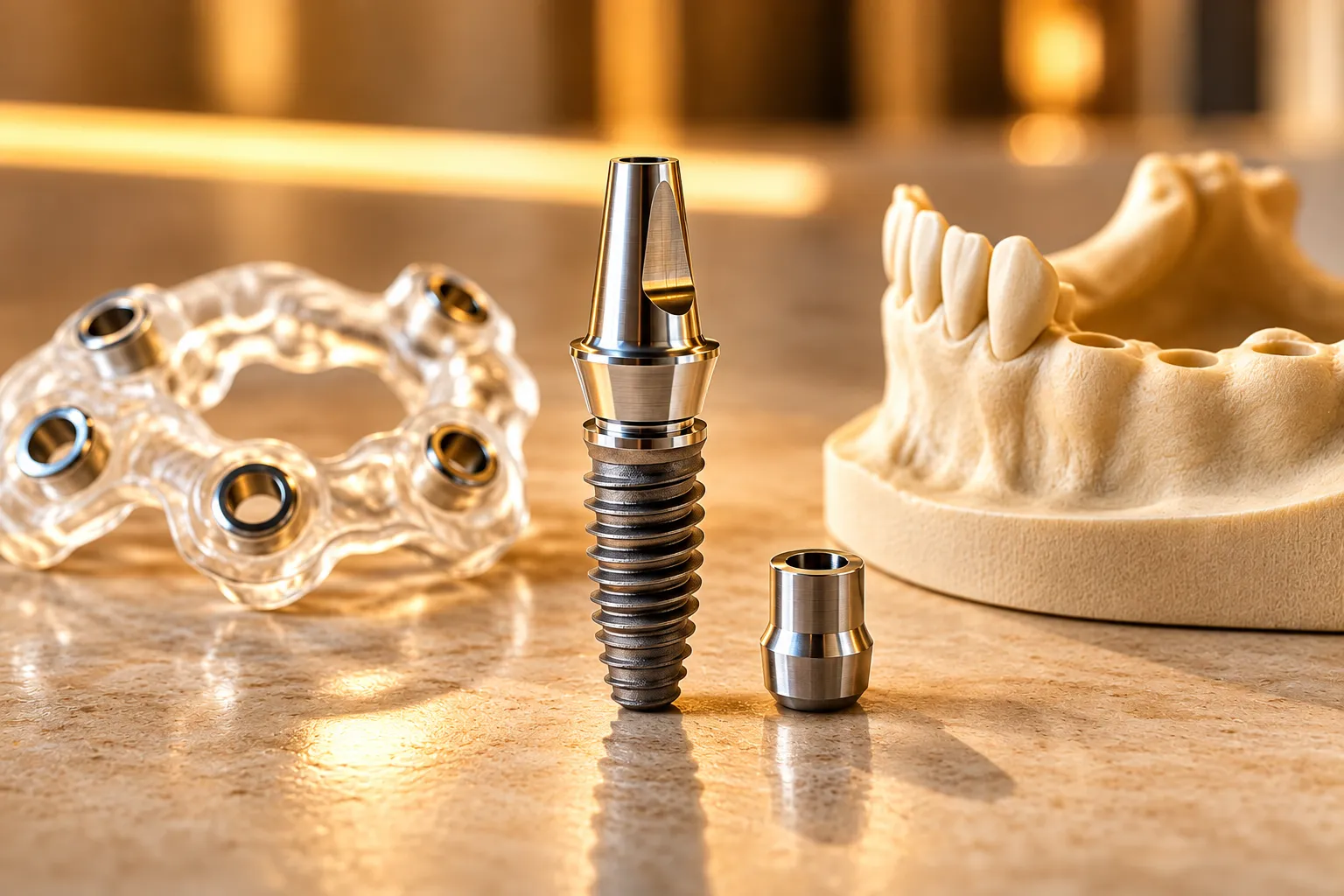
A single tooth implant replaces one missing tooth entirely on its own — root and crown — without involving the teeth on either side. It is the most conservative option available for a single tooth replacement, and for most patients the most durable.
The comparison that matters is with a conventional three-unit bridge. To carry a bridge, the two healthy teeth flanking the gap have to be ground down to stumps and crowned. Two intact teeth are permanently altered to replace one missing one, they become vulnerable to decay beneath their crowns, and if either fails later the whole bridge fails with it. An implant leaves both of them untouched.
The second difference is beneath the gum. A bridge spans the gap but leaves the ridge below unsupported, so the bone that once held the root continues to resorb and a dip gradually develops under the replacement tooth. An implant occupies that space and keeps the bone loaded, which is why the ridge holds its shape.
The trade-off is time. A bridge can be finished in a couple of weeks; an implant needs months for the bone to bond to it before the crown goes on. What you get for that wait is a tooth that stands alone, cleans like a natural tooth, and doesn’t put two healthy neighbors at risk.
Who it’s for
- A single missing tooth anywhere in either jaw
- A tooth that can’t be saved and is scheduled for removal
- A congenitally missing tooth, commonly an upper lateral incisor
- A tooth lost to trauma, fracture, or a failed root canal
- A preference for a fixed solution over a removable flipper or partial
- Wanting to avoid grinding down healthy neighboring teeth for a bridge
- An existing bridge that has failed and needs replacing
What to expect
- 1
Evaluation & 3D imaging
A comprehensive exam with CBCT imaging confirms bone volume, the position of adjacent roots and nerves, and the exact placement position.
- 2
Site preparation if needed
If the tooth is still present it is removed and the socket grafted; if the site has already resorbed, it may need augmenting before placement.
- 3
Implant placement
The implant is placed into the jawbone, usually under local anesthesia, in an appointment most patients find shorter and easier than an extraction.
- 4
Healing & integration
The bone bonds to the implant surface — osseointegration — over the following months. A temporary tooth fills the gap during this time.
- 5
Uncovering & impressions
The implant is uncovered, a healing abutment shapes the gum, and the site is scanned for the final crown.
- 6
Abutment & crown
A custom abutment is fitted and the final ceramic crown is placed, matched to the adjacent teeth in shade, contour, and translucency.
Recovery & aftercare
Most patients are comfortable with over-the-counter pain relief and return to routine activities within a day or two. Mild swelling in the first few days is normal. A surprising number of people report the implant placement was easier than the extraction that preceded it.
Eat softly on the other side for the first week or so and keep the area clean without brushing directly over the surgical site until cleared. If you have a temporary tooth, avoid biting into anything with it.
The implant then heals quietly beneath or through the gum while it integrates. This phase is uneventful — there’s nothing to do but wait — and the crown is fitted once the foundation has proved solid.
Common questions
- How long does the whole process take?
- Commonly several months from placement to final crown, driven by how long the bone takes to bond to the implant. It runs longer if the site needs grafting first, and shorter in the selected cases where an implant can be placed the same day the tooth comes out.
- Will it look like my natural tooth?
- That’s the goal, and it’s most demanding at front teeth. The crown is custom-made to match its neighbors in shade, shape, and translucency, and the gum contour around it is shaped during healing so the tooth emerges naturally. Front-tooth cases are planned with more attention to the soft tissue than back teeth need.
- Implant or bridge — which should I choose?
- An implant if the neighboring teeth are healthy, because a bridge means grinding them down. A bridge can be the more sensible choice if those teeth already need crowns anyway, if there’s insufficient bone and you’d rather not graft, or if you need the gap closed quickly. We’ll go through both rather than assume.
- Will I have a gap while it heals?
- No. A temporary tooth — a bonded provisional, a small removable flipper, or an immediate provisional crown on the implant in suitable cases — fills the space throughout. Front teeth are always provisionalized.
- Do I need to do anything different to clean it?
- Brush and floss it like a natural tooth. The implant can’t decay, but the gum and bone around it can become inflamed exactly as they do around teeth, so daily cleaning and regular professional maintenance still matter.
- How long will a single implant last?
- Implants routinely last decades, and many last for life. The crown on top is a restoration and may need replacing at some point over that span. The main threats to longevity are peri-implantitis and untreated heavy grinding — both manageable with maintenance and, where needed, a night guard.
- What if I just leave the gap?
- It’s an option for some back teeth, but it isn’t free. The bone at the site resorbs, adjacent teeth can drift or tip into the space, and the opposing tooth can over-erupt. Any of these makes replacing the tooth later more complex than replacing it now.
- Does it hurt?
- Placement is done under local anesthesia and is painless at the time. Afterward, most patients describe mild soreness for a couple of days managed with over-the-counter medication — noticeably less than they expected.
Want a second opinion first?
If you’ve been quoted implant, bone-grafting, or sinus-lift treatment and want to be sure it’s the right plan, a specialist second opinion is a low-cost, no-pressure way to confirm your options before you commit.
Request a second opinionTalk to a specialist about single tooth dental implant
Whether you’re a patient considering treatment or a dentist referring a case, we’ll evaluate, plan, and coordinate care from diagnosis through follow-up.
Sources
This information is provided for educational purposes and is not a substitute for a professional evaluation. Diagnosis and treatment should always be determined by a qualified dental professional based on your individual condition.