


Dental Implant Dentistry
Multiple Dental Implants
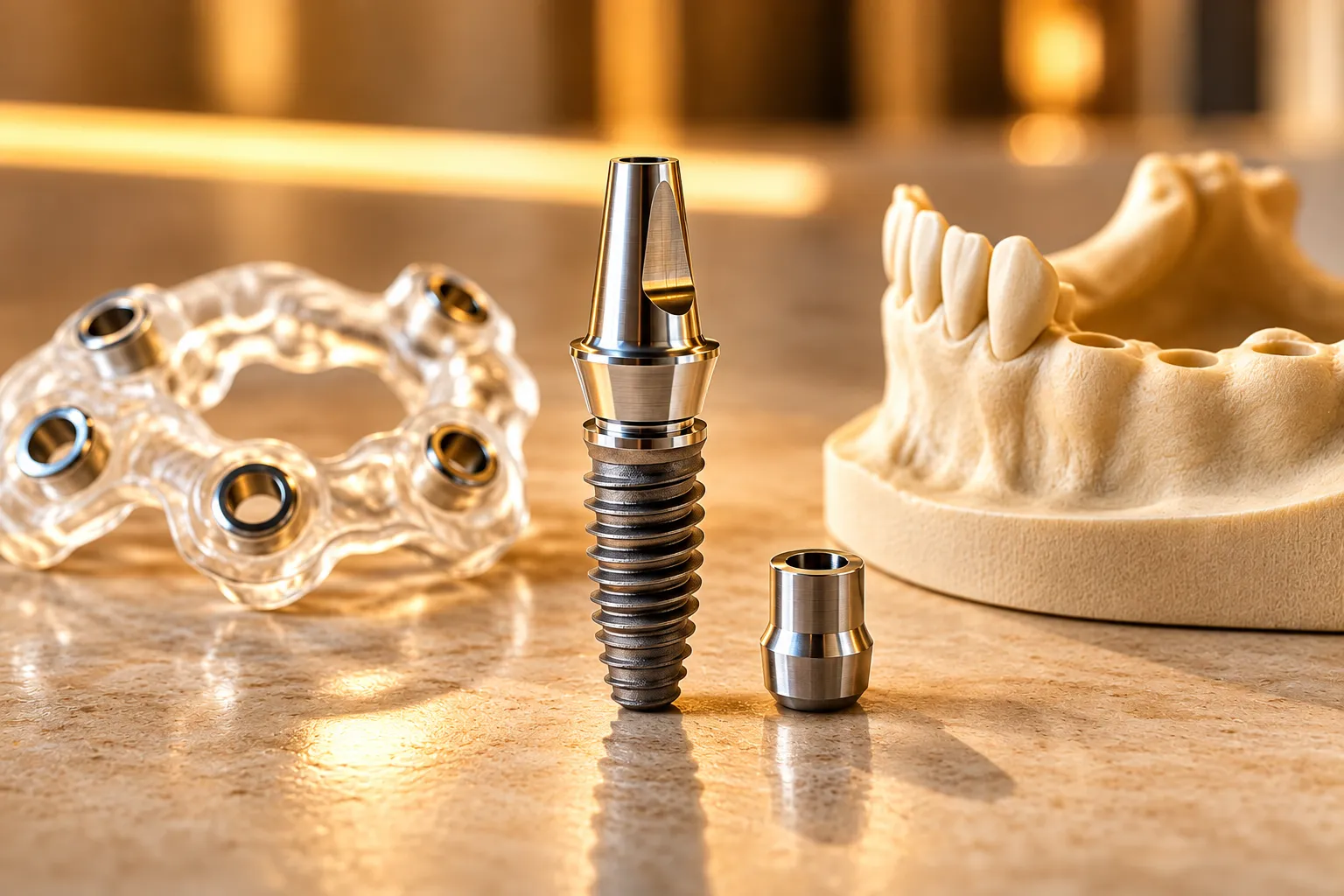
Replacing Multiple Missing Teeth With Implants
When several teeth are missing, dental implants provide a fixed, stable, long-lasting replacement without a removable partial denture and without cutting down healthy teeth to carry a conventional bridge. The number of implants and where they go is planned around your bone, the position of the gaps, and how your bite loads them.
The most common misconception about multiple implants is that you need one for every missing tooth. You usually don’t. Implants are strong enough to carry more than their own tooth, so two well-positioned implants can support a fixed bridge spanning three or four teeth. The number is a planning decision, not an arithmetic one.
What actually drives the plan is where the gaps sit and what the bone will support. Two separated single gaps are treated quite differently from four missing teeth in a row, which is different again from a scattered pattern across both sides of an arch. Load distribution matters too — molars absorb far more chewing force than front teeth, and the plan has to account for that.
The alternative most patients are weighing this against is a removable partial denture. A partial is cheaper and faster, but it rests on the gums, clasps onto remaining teeth, moves when you eat, and does nothing to stop the bone beneath it from continuing to shrink. Implants replace the roots as well as the crowns, which is why the bone stays.
Ways multiple implants are configured
The right configuration depends on how many teeth are missing, whether they sit together or apart, and how much bone is available to work with.
Individual implants and crowns
One implant per missing tooth, each with its own crown. The natural choice when the gaps are separated, and it keeps each tooth independently cleanable and repairable.
Implant‑supported bridge
Two or more implants anchor a fixed bridge across several adjacent missing teeth — fewer implants, full stability, and often a lower total cost.
Combined single and bridge units
Most real arches are a mix. Isolated gaps get their own implant while runs of missing teeth are bridged, all planned as one restoration.
Strategic placement for a larger span
When most of an arch is gone, implants are positioned to distribute the bite forces across a larger fixed restoration rather than replacing teeth one for one.
Who it’s for
- Several missing teeth in one or both jaws
- Missing back teeth making it hard to chew on one or both sides
- A preference for fixed teeth over a removable partial denture
- An existing partial denture that is uncomfortable, loose, or embarrassing
- Wanting to avoid grinding down healthy teeth to anchor a conventional bridge
- Preserving jawbone volume and facial support where teeth have been lost
- Several failing teeth expected to need removal in the near future
What to expect
- 1
Evaluation & 3D planning
CBCT imaging and digital planning establish how many implants are needed, exactly where they go, and whether any site needs bone added first.
- 2
Sequencing the plan
Any extractions, grafting, or site preparation is scheduled ahead of placement, and the restorative design is agreed with your dentist before surgery rather than after.
- 3
Implant placement
The implants are placed in the planned positions in a single surgical visit where possible, usually under local anesthesia with sedation available.
- 4
Healing & integration
The implants integrate with the bone over the following months. A temporary restoration keeps you functioning and presentable in the meantime.
- 5
Impressions & design
Once integrated, the implants are uncovered and scanned, and the final crowns or bridge are designed around your bite and appearance.
- 6
Fitting the restoration
Individual crowns or an implant-supported bridge are fitted and the bite is balanced across all the implants, in coordination with your restoring dentist.
Recovery & aftercare
Recovery is broadly similar to single-implant surgery, not multiplied by the number of implants — mild swelling and soreness for a few days, managed with standard pain relief and a softer diet early on. Placing several implants in one visit is generally a better experience than several separate surgeries.
Expect to eat softly for a week or two and to keep the surgical sites clean without brushing directly over them until cleared. If you wear a temporary partial over the area, it will be adjusted so it doesn’t press on the healing implants.
The integration period runs for months rather than weeks, and the final restoration is staged with your restoring dentist once the implants have proved stable. Most patients find this phase uneventful — the implants heal quietly beneath the gum while a provisional keeps things functional.
Common questions
- Do I need an implant for every missing tooth?
- No, and usually you shouldn’t. Implants are strong enough to carry a span, so two implants can support a fixed bridge replacing three or four teeth. Fewer, well-positioned implants often produce a better result than one per tooth — and cost less.
- How many implants will I actually need?
- It depends on how many teeth are missing, whether they’re adjacent or scattered, how much bone is available, and how hard you bite. Separated gaps generally need their own implants; teeth in a row can share support. The number is settled at the planning stage, after imaging.
- Is this better than a partial denture?
- For most people, yes — but they’re genuinely different propositions. Implants are fixed, stable, preserve bone, and don’t clasp onto your remaining teeth. A partial is quicker and less expensive up front, but it moves, covers more of your mouth, and lets the bone beneath it continue to shrink. The right answer depends on your circumstances, and we’ll go through both.
- Can implants and natural teeth be joined in the same bridge?
- Generally no. Implants are rigidly fixed in bone while natural teeth have a ligament that lets them move very slightly under load. Connecting the two puts uneven stress on both, so an implant bridge is normally supported by implants alone.
- Can all the implants be placed in one appointment?
- Usually, yes. Multiple implants are commonly placed in a single surgical visit, which means one recovery period rather than several. Where sites need grafting first, or where extractions have to heal, the treatment is staged.
- Will I be without teeth while they heal?
- No. A temporary restoration — a provisional bridge or an adapted partial — keeps you functional and presentable throughout integration. Nobody is sent home with visible gaps.
- What happens if one implant fails?
- With multiple implants, one failing is far less disruptive than it sounds. The site is allowed to heal, grafted if needed, and a replacement placed — often without disturbing the others. Where the bridge design allows, the remaining implants may even carry it in the interim.
- Is it cheaper than replacing each tooth individually?
- Frequently, yes. Because a few implants can support a multi-tooth bridge, treating several missing teeth together often costs less per tooth than treating them one at a time — one of the reasons planning the whole arch at once is worth doing.
Want a second opinion first?
If you’ve been quoted implant, bone-grafting, or sinus-lift treatment and want to be sure it’s the right plan, a specialist second opinion is a low-cost, no-pressure way to confirm your options before you commit.
Request a second opinionTalk to a specialist about multiple dental implants
Whether you’re a patient considering treatment or a dentist referring a case, we’ll evaluate, plan, and coordinate care from diagnosis through follow-up.
Sources
This information is provided for educational purposes and is not a substitute for a professional evaluation. Diagnosis and treatment should always be determined by a qualified dental professional based on your individual condition.