
Dental Implant Dentistry
Implant Maintenance
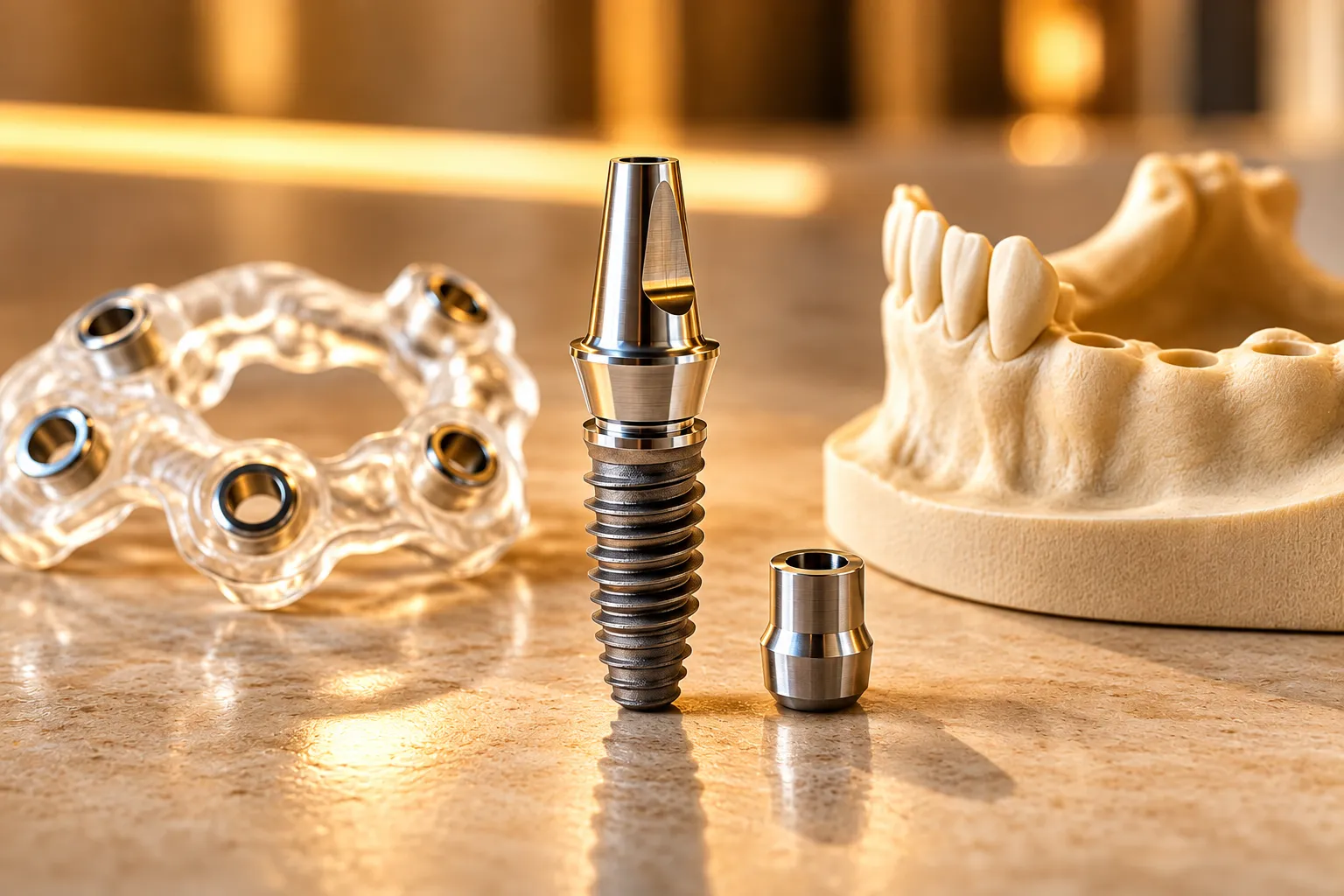
Dental implants don’t decay, but the gum and bone around them still need ongoing care. Implant maintenance is specialized professional monitoring and cleaning of the tissues around your implants, designed to catch early inflammation before it threatens the bone that holds the implant in place.
Without regular care, plaque and bacteria can build up around an implant and lead to peri-implant disease — inflammation of the surrounding gum (peri-implant mucositis) or loss of supporting bone (peri-implantitis). Routine maintenance, alongside good home care, is the most effective way to keep implants healthy long-term.
Who it’s for
- Anyone with one or more dental implants
- Full-arch, hybrid, or implant-supported bridge patients
- A history of gum disease — the strongest single risk factor for peri-implant disease
- Early signs of inflammation: bleeding, redness, or swelling around an implant
- Smokers, who carry a substantially higher risk of peri-implant bone loss
- Implant restorations that are difficult to clean around or beneath
- Patients whose implants were placed elsewhere and are not being monitored
What to expect
- 1
Implant & tissue check
We examine the implant and restoration, probe the tissue around it, and record bleeding — the earliest reliable warning that something is changing.
- 2
Comparison against baseline
Findings are measured against your previous records rather than assessed in isolation. Peri-implant disease is diagnosed by change over time, not by a single reading.
- 3
Professional cleaning
Plaque and deposits are removed with instruments selected to clean thoroughly without scratching the implant surface, which conventional metal scalers can do.
- 4
Radiographic monitoring
Imaging is taken at intervals to confirm bone levels are stable — bone loss around an implant is usually invisible and painless until it is advanced.
- 5
Restoration check
The crown or bridge is checked for loose screws, worn contacts, and food trapping, and the bite is verified for overload.
- 6
Home-care guidance
Tailored technique advice for your specific restoration, since cleaning a single crown, a bridge, and a full-arch prosthesis are three different tasks.
Recovery & aftercare
Maintenance is non-invasive, so there is no downtime. Any mild tenderness from thorough cleaning around an inflamed site settles within a day.
Keeping a regular maintenance schedule — coordinated with your general dentist or hygienist — is the single greatest determinant of how long implants last. The surgery gets the implant in; maintenance is what keeps it there.
If early inflammation is found, treatment is usually straightforward: thorough decontamination, improved home care, and a shortened recall interval. Caught at that stage it rarely needs surgery.
Common questions
- Do implants need special cleaning?
- Daily care is much like natural teeth — brushing and cleaning between them. Professional care is different: implant surfaces are softer than enamel and can be scratched by conventional steel scalers, so instruments are chosen specifically to avoid roughening a surface that plaque would then cling to.
- What is peri-implantitis?
- Inflammation with bone loss around an implant, driven by bacterial buildup. Its earlier stage, peri-implant mucositis, involves inflamed gum but no bone loss and is reversible with treatment. Once bone has been lost it does not come back on its own — which is why the whole point of maintenance is catching it at the mucositis stage.
- How often do I need implant maintenance?
- It’s set to your individual risk rather than a standard interval. Many patients are seen every few months, particularly those with a history of periodontal disease, smokers, and full-arch patients. Low-risk patients with a single implant may need less. We set the interval and revise it based on what we find.
- My implant feels fine. Why do I need to come in?
- Because peri-implantitis is usually painless until it’s advanced. Implants have no nerve and no ligament, so they don’t give you the early warning signals a diseased tooth would. By the time an implant feels loose, substantial bone has already gone. Monitoring exists precisely to cover that blind spot.
- Can I just have my regular hygienist do it?
- For many patients, yes — and we coordinate with them. Specialist maintenance is worth it where there’s a history of peri-implant disease, a complex full-arch prosthesis, or a site that needs close monitoring. It isn’t either/or; often it’s alternating visits.
- How do I clean under a bridge or full-arch prosthesis?
- With a water flosser, superfloss or floss threaders, and interdental brushes sized to the spaces. A toothbrush cannot reach beneath a fixed prosthesis, and this is where the problems start. We’ll go through the technique for your specific restoration and check you’re getting to everything.
- Can implants get cavities?
- No — there’s no enamel or dentin to decay. That’s precisely why people underestimate the risk. The implant can’t decay, but the gum and bone holding it can be destroyed by exactly the same plaque bacteria, which is a far more serious problem than a cavity.
- My gum bleeds when I clean around my implant. Is that a problem?
- It’s worth having looked at promptly. Bleeding around an implant is the earliest sign of peri-implant inflammation, and at that stage it’s usually reversible with thorough cleaning and better home care. Left alone, it’s the stage that precedes bone loss.
Want a second opinion first?
If you’ve been quoted implant, bone-grafting, or sinus-lift treatment and want to be sure it’s the right plan, a specialist second opinion is a low-cost, no-pressure way to confirm your options before you commit.
Request a second opinionTalk to a specialist about implant maintenance
Whether you’re a patient considering treatment or a dentist referring a case, we’ll evaluate, plan, and coordinate care from diagnosis through follow-up.
Sources
This information is provided for educational purposes and is not a substitute for a professional evaluation. Diagnosis and treatment should always be determined by a qualified dental professional based on your individual condition.