


Dental Implant Dentistry
Comprehensive Implant Evaluation
What Is a Comprehensive Implant Evaluation?
A successful dental implant begins long before the surgery. The comprehensive implant evaluation is the appointment where the entire case is worked out — bone volume and quality, gum health, the position of nerves and sinuses, how your bite loads the area, and what the finished tooth needs to look like.
The principle behind it is that implant placement is restoratively driven. The implant goes where the tooth needs to be, and everything else — how much bone has to be built, which technique is used, whether the site can take an implant immediately — follows from that. Working in the opposite direction, placing an implant wherever the bone happens to be and then trying to build a tooth on it, is how compromised results happen.
Most of what this appointment finds is invisible on a normal dental X-ray. A conventional radiograph is a flat image of a three-dimensional structure; it cannot show you how wide a ridge is, where the nerve canal actually runs, or how far the sinus has expanded. CBCT imaging shows all three, which is why it has become standard for implant planning.
The evaluation is also where you find out whether implants are the right choice at all. Sometimes the honest answer is that a site needs grafting first, that a tooth thought to be hopeless can actually be saved, or that a different restorative option fits your circumstances better. That conversation is part of the appointment.
Who it’s for
- Considering dental implants and wanting to know whether you’re a candidate
- One or more missing, failing, or non-restorable teeth
- Previous bone loss or a difficult site that needs careful planning
- Told elsewhere that you don’t have enough bone for implants
- Risk factors — smoking, diabetes, certain medications — to assess before surgery
- A history of gum disease, which raises the risk of peri-implant problems
- Seeking a second opinion on an implant plan you’ve been given
What to expect
- 1
History & goals
Your medical history, medications, and what you actually want from treatment. Some medications and health conditions materially change implant planning, so this isn’t a formality.
- 2
Clinical examination
Gum and bone health around the remaining teeth, the amount and quality of gum tissue at the implant site, and how much of it shows when you smile.
- 3
3D CBCT imaging
A CBCT scan maps bone volume and density in three dimensions and locates the nerve canal and sinus floor, so placement can be planned around them precisely.
- 4
Digital scanning & smile analysis
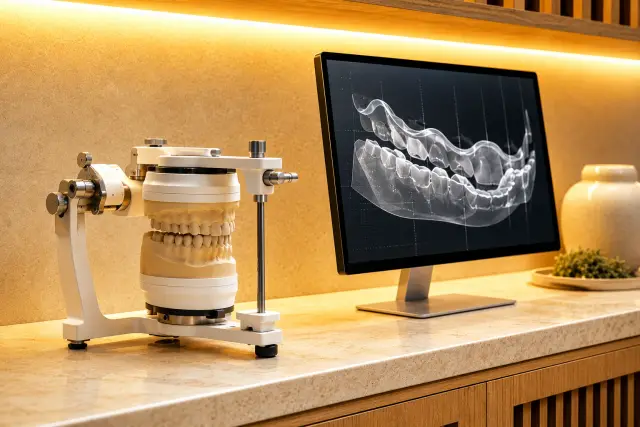
Intraoral scanning captures your teeth and bite; where appearance matters, the planned tooth position is designed before the implant position is fixed.
- 5
Bite assessment
How your teeth meet, whether you grind, and how force will be distributed onto the implant — one of the most under-examined causes of long-term implant problems.
- 6
Plan, options & costs
The findings are reviewed with you, along with what each option involves, how long it takes, the alternatives, and what it costs — in writing, before you commit to anything.
Recovery & aftercare
The evaluation is entirely non-invasive, so there is no recovery period. The CBCT scan itself takes well under a minute and involves no injection or discomfort.
Planning every case in advance is what allows for more minimally invasive surgery, fewer surprises during the procedure, and more predictable esthetic outcomes. The time spent here is what shortens and simplifies everything that follows.
You leave with a plan you can consider rather than a decision you have to make in the chair. Most patients take it away, discuss it, and come back — which is the way it should work.
Common questions
- Do I really need a CT scan for implants?
- For any implant, yes. A standard dental X-ray is a two-dimensional image and can’t show ridge width, the true path of the nerve canal, or the position of the sinus floor. Planning an implant without that information means estimating structures you should be measuring.
- How much radiation is in a CBCT scan?
- A dental CBCT scan uses a small fraction of the dose of a medical CT of the head, and it is limited to the jaw area. It is a meaningfully higher dose than a single dental X-ray, which is why it is taken when it will change the plan — for implant surgery it essentially always does.
- How long does the evaluation appointment take?
- Usually around an hour, depending on how many sites are involved and whether existing implant problems are being assessed. Complex full-arch cases take longer and sometimes need a second planning visit.
- Can implants be placed the same day as an extraction?
- In selected cases, yes. Immediate placement needs enough healthy bone beyond the socket, no active infection, and sufficient stability at placement. The evaluation is precisely what determines whether your site meets those conditions.
- I was told I’m not a candidate for implants. Is a second opinion worth it?
- Often, yes. Not a candidate usually means not a candidate without further work — ridge augmentation, sinus elevation, or guided bone regeneration change what’s possible. It occasionally does mean genuinely unsuitable, and we’ll tell you that plainly if it’s the case.
- Will I find out what it costs at this appointment?
- Yes. You receive a written plan setting out the stages, the timeline, and the cost of each phase, including any grafting. Estimating implant costs before the scan isn’t meaningful, because the scan is what determines whether grafting is needed.
- Does smoking or diabetes rule me out?
- Neither is an automatic exclusion, but both raise the risk of implant failure and peri-implant disease and both change how the case is planned. Well-controlled diabetes is generally not a barrier. Smoking is the more significant factor, and reducing or stopping around the surgery measurably improves the odds.
- What if the evaluation shows I need grafting first?
- Then that becomes stage one of the plan, with the implant following after the graft has matured. It extends the timeline but it is routine — a large share of implant cases involve some bone augmentation, and the planning stage is exactly where that’s identified rather than discovered mid-surgery.
Want a second opinion first?
If you’ve been quoted implant, bone-grafting, or sinus-lift treatment and want to be sure it’s the right plan, a specialist second opinion is a low-cost, no-pressure way to confirm your options before you commit.
Request a second opinionTalk to a specialist about comprehensive implant evaluation
Whether you’re a patient considering treatment or a dentist referring a case, we’ll evaluate, plan, and coordinate care from diagnosis through follow-up.
Sources
This information is provided for educational purposes and is not a substitute for a professional evaluation. Diagnosis and treatment should always be determined by a qualified dental professional based on your individual condition.