
Advanced Periodontal Care
Regenerative Periodontal Therapy
What Is Periodontal Regeneration?
Regenerative periodontal therapy — periodontal regeneration, or regenerative periodontal surgery — aims to rebuild the structures that gum disease has destroyed: the bone, the periodontal ligament, and the attachment holding the tooth in its socket. Rather than only halting the disease, it attempts to recover support that has already been lost.
That distinction is what separates regeneration from the rest of periodontal treatment. Scaling and root planing and pocket-reduction surgery both work by removing infection and reshaping the site so it can be kept clean — they stop further destruction, but the bone that has gone stays gone, and the pocket is reduced by moving the gum down rather than by building the bone back up. Regeneration reverses part of the loss.
The biology it exploits is the same one that makes guided bone regeneration work. When a periodontal defect heals unassisted, the tissues race to fill it and the fast-growing gum epithelium wins, forming a long, weak attachment along the root rather than genuine new support. Regeneration excludes that tissue — with a barrier membrane, a graft, or a biologic agent applied to the cleaned root surface — so that ligament and bone can occupy the space instead.
Not every defect can be regenerated, and being honest about which can is central to the discipline. Deep, narrow defects with bone walls around them respond well. Broad, shallow, flat-bottomed defects with no containing walls generally do not, because there is nothing to hold the graft and no adjacent bone to grow from. The evaluation exists to distinguish the two — and, where regeneration isn’t realistic, to say so and discuss extraction and implant replacement instead.
Regenerative techniques
Regeneration is tailored to the defect, and most cases combine more than one of these approaches rather than relying on a single agent.
Bone grafting materials
Graft material fills the defect and acts as a scaffold, holding the space open so new bone can form into it rather than the space collapsing.
Guided tissue regeneration
A barrier membrane over the defect excludes the fast-growing gum epithelium, giving the slower ligament and bone cells time to repopulate the root surface.
Enamel matrix derivative
A protein preparation applied to the conditioned root surface that recreates conditions favoring true periodontal attachment rather than a scar-like healing.
Growth factors & biologics
Concentrated biologic signals used to stimulate the body’s own regenerative cells, often combined with a graft to hold the space.
Who it’s for
- Vertical or angular bone defects around a tooth — the classic regenerative indication
- Deep, isolated periodontal pockets that persist after non-surgical treatment
- Advanced localized periodontitis affecting a small number of teeth
- Furcation defects, where bone has been lost between the roots of a molar
- Teeth with a guarded but salvageable prognosis that you want to keep
- Patients who have been told a tooth is hopeless and want it reassessed
- Sites where preserving the natural tooth is preferable to implant replacement
What to expect
- 1
Assessment & planning
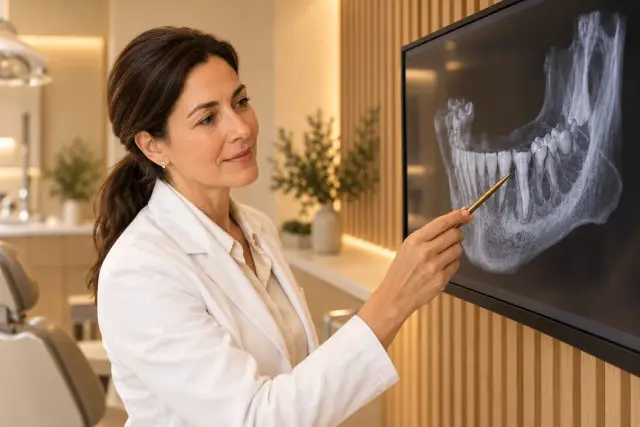
Probing depths, attachment levels, and imaging define the exact shape of the defect. The number of surrounding bone walls is the single strongest predictor of whether regeneration will work.
- 2
Controlling the infection first
Regeneration is never the first step. The disease must be brought under control with non-surgical therapy, and your home care has to be effective, before surgery is worth doing.
- 3
Surgical access
Under local anesthesia the gum is elevated with a technique designed to preserve the tissue between the teeth, which is what will cover and protect the site.
- 4
Root surface preparation
The root is thoroughly debrided and conditioned. New attachment can only form onto a root surface that has been cleared of the biofilm and calculus embedded in it.
- 5
Regenerative materials
The defect is filled with graft material and treated with a barrier membrane, growth factors, or an enamel matrix derivative — often more than one in combination.
- 6
Closure
The flap is repositioned to cover the site completely, without tension. Keeping the material covered is decisive for the outcome.
- 7
Maturation & monitoring
The site rebuilds over the following months. We re-measure and re-image to confirm what has actually been gained.
Recovery & aftercare
Mild swelling and soreness for a few days are typical and managed with standard pain relief. Regenerative surgery is generally less uncomfortable than patients expect, and often less so than pocket-reduction surgery.
The instructions are restrictive on purpose. Do not brush or floss the surgical site until told otherwise — mechanical disturbance in the early weeks is the most common cause of regenerative failure. You’ll typically be given an antimicrobial rinse to use instead, and asked to eat softly and avoid the area entirely.
Regenerated support matures gradually over months rather than weeks, and the result is confirmed by re-probing and imaging rather than assumed. Long-term maintenance is not optional afterward: regenerated attachment is as susceptible to the disease that destroyed the original as anything else, and the gain is lost if the infection returns.
Common questions
- Can all bone loss be regenerated?
- No, and this is the most important limitation to understand. Success depends on the shape of the defect. Deep, narrow defects contained by surrounding bone walls respond predictably. Broad, shallow, horizontal bone loss — the most common pattern in generalized periodontitis — generally cannot be regenerated, because there is no containment and nothing for the new bone to grow from.
- How is this different from pocket-reduction surgery?
- They solve the same problem from opposite directions. Pocket reduction removes infection and repositions the gum lower so the pocket is shallow and cleanable — the bone level is unchanged or reshaped. Regeneration attempts to rebuild the bone and attachment so the pocket resolves by filling in. Regeneration is preferable where the defect suits it; pocket reduction is the reliable option where it doesn’t.
- Is regeneration better than extracting the tooth and placing an implant?
- It depends entirely on the tooth’s prognosis. A tooth that can be predictably saved is generally worth saving — nothing replaces a natural root and its ligament. But regenerating a tooth that then fails two years later has cost you time, money, and often bone that could have supported an implant. We give you an honest assessment of which side of that line your tooth falls on.
- What are enamel matrix derivatives and growth factors?
- Biologic agents applied to the prepared root surface to encourage the cells that form ligament and bone rather than the epithelium that would otherwise invade. Enamel matrix derivative is a protein preparation that mimics the environment in which periodontal attachment originally develops. They are used alone or alongside a graft depending on the defect.
- How much bone will I actually get back?
- Partial recovery, not complete reconstruction. Successful regeneration typically fills a meaningful share of the defect and gains measurable attachment — enough to change a tooth’s prognosis, which is the clinical point. Expecting the bone to return to its original level is not realistic and we won’t suggest it will.
- Will it work if I smoke?
- Substantially less well. Smoking is the single strongest modifiable risk factor for regenerative failure — it impairs the blood supply and healing the entire procedure depends on. We will still discuss it, but we’ll be direct that the odds are materially worse and that stopping changes them.
- How long before we know whether it worked?
- Meaningful assessment takes months. Probing too early disrupts the fragile new attachment, so the site is left undisturbed and formally re-evaluated later, with imaging to compare bone levels against the pre-operative baseline.
- Can regeneration be repeated if it doesn’t work?
- Sometimes, though a second attempt at the same site is usually less predictable than the first. More often, if regeneration hasn’t achieved enough, the discussion shifts to pocket reduction to make the site maintainable, or to extraction and replacement.
Talk to a specialist about regenerative periodontal therapy
Whether you’re a patient considering treatment or a dentist referring a case, we’ll evaluate, plan, and coordinate care from diagnosis through follow-up.
Sources
This information is provided for educational purposes and is not a substitute for a professional evaluation. Diagnosis and treatment should always be determined by a qualified dental professional based on your individual condition.