

Advanced Periodontal Care
Tooth Exposure for Orthodontics
Tooth exposure is a minor surgical procedure that assists orthodontic treatment when a tooth fails to erupt on its own — most commonly an impacted canine. Teeth may stay impacted because of limited space, an abnormal eruption path, or thick gum or bone coverage.
The gum tissue covering the impacted tooth is gently opened to expose its surface; in some cases a small amount of bone is removed. An orthodontic bracket may be attached so the tooth can be guided into position. We work closely with your orthodontist for a controlled, predictable result.
Upper canines are by far the most common tooth involved, and they are worth the effort to save. They are the longest-rooted teeth in the mouth, they carry a disproportionate share of the bite as the jaw moves sideways, and they frame the smile — a canine replaced by an implant or a moved premolar is never quite the same thing. Because they are also the last front teeth to erupt, they are the most likely to run out of room or drift off course.
Timing matters more here than in most procedures. An impacted canine caught in the early teens can usually be guided into place; the same tooth left another decade often becomes fused to the bone and immovable, and by then it may have resorbed the root of the incisor beside it. This is why orthodontists screen for canine position rather than waiting to see whether the tooth appears.
How the tooth is uncovered also affects the final appearance. Simply cutting away the gum over a canine leaves it with a thin, uneven band of tissue that shows for life; a closed technique that repositions the tissue and lets the tooth erupt beneath it produces gum contour that matches its neighbors.
Who it’s for
- An impacted tooth that hasn’t erupted naturally — most often an upper canine
- Patients in or beginning orthodontic treatment
- A baby canine still present well past the age it should have been replaced
- Asymmetry where one canine has erupted and the other hasn’t
- Teeth trapped by thick gum or overlying bone
- Imaging showing an impacted tooth resorbing the root of a neighboring tooth
- Preserving natural teeth rather than extracting and replacing them
What to expect
- 1
3D imaging & planning
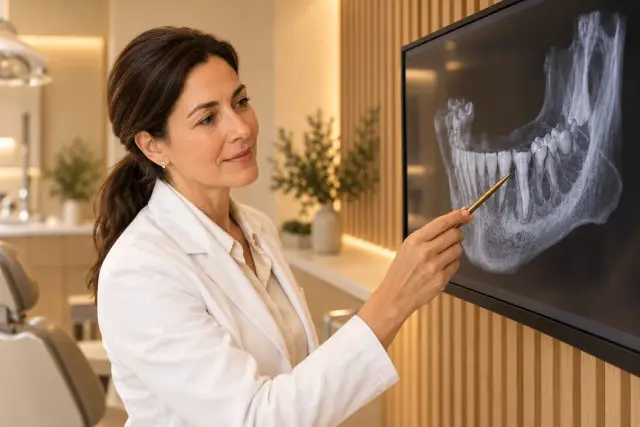
CBCT imaging locates the tooth precisely in three dimensions — how it’s angled, which side of the arch it sits on, and whether it is damaging adjacent roots.
- 2
Coordination with your orthodontist
Space has to be created in the arch before traction starts, so the surgical timing is agreed with the orthodontic plan rather than scheduled independently.
- 3
Choosing the technique
Open or closed exposure, decided by how deep the tooth is and how much it matters that the final gum contour matches the neighboring teeth.
- 4
Exposure
Under local anesthesia the tissue over the tooth is opened and, where needed, a small amount of overlying bone is removed to reveal the crown.
- 5
Bracket attachment
An orthodontic bracket and gold chain are bonded to the exposed surface, and the chain is brought out where the orthodontist can reach it.
- 6
Guided eruption
Your orthodontist applies light, controlled traction over months to bring the tooth along its planned path into the arch.
- 7
Final positioning
Once in the arch, the tooth is aligned and the gum contour around it is assessed — occasionally refined with a minor soft-tissue procedure.
Recovery & aftercare
Mild tenderness and some swelling for a few days is typical, managed with simple aftercare and over-the-counter pain relief. The chain attached to the tooth may feel odd against the lip or tongue at first; orthodontic wax helps until you’re used to it.
Soft food for a few days, and gentle cleaning around the site without disturbing the chain. If the chain detaches — uncommon but not rare — it needs re-bonding, so let us know rather than waiting for the next orthodontic visit.
How long the tooth takes to move into place depends on your orthodontic treatment and varies considerably — deeply impacted or badly angled teeth travel further and take longer. It is a gradual process measured in months, and slow, light traction is what protects the tooth’s root and the bone it travels through.
Common questions
- Is this necessary for all impacted teeth?
- No. Each case is evaluated individually. Some impacted teeth — particularly wisdom teeth — are better removed than guided in. Canines are usually worth saving because of their role in the bite and the smile, but even then the decision depends on the angle, the depth, and the patient’s age.
- How long before the tooth comes into place?
- Usually many months, sometimes longer than a year for a deeply or awkwardly positioned tooth. Traction is deliberately light and slow — moving a tooth quickly through bone risks damaging its root and the surrounding support.
- What’s the difference between open and closed exposure?
- Open exposure leaves the crown uncovered to erupt through the gum. Closed exposure bonds a chain to the tooth and replaces the gum over it, so the tooth erupts beneath its own tissue. Closed generally gives better final gum contour and is preferred for canines in the smile zone; open is simpler and suits teeth that are shallow or less visible.
- What happens if we do nothing?
- The risks accumulate with time. An impacted canine can resorb the root of the incisor next to it — sometimes severely enough to lose that tooth — and can develop a cyst. It also becomes progressively harder to move as the patient ages and can eventually fuse to the bone, at which point the only option is removal.
- Is my child too old for this?
- Earlier is easier, but adults are treated successfully too. The concern with age is ankylosis, where the tooth fuses to surrounding bone and won’t move despite correct traction. That’s assessed during treatment, and if a tooth proves immobile the plan shifts to extraction and replacement.
- Will the tooth look normal once it’s in?
- Usually, yes — that’s a large part of why the technique is chosen carefully. A tooth brought in under a closed exposure typically ends up with gum contour matching its neighbors. Occasionally a minor soft-tissue procedure at the end refines the margin.
- Does the exposed tooth need a root canal?
- No. The tooth is alive and stays alive — exposure and traction don’t affect the nerve. The bracket is bonded to the enamel surface exactly as an orthodontic bracket is on any other tooth.
- Can the baby tooth just be left in place?
- It’s a stopgap at best. Retained baby canines have short roots and eventually fail, usually in adulthood, leaving a gap in a prominent part of the smile at a point when the adult tooth is no longer movable. Dealing with it while the adult tooth can still be brought in is the better plan.
Talk to a specialist about tooth exposure for orthodontics
Whether you’re a patient considering treatment or a dentist referring a case, we’ll evaluate, plan, and coordinate care from diagnosis through follow-up.
Sources
This information is provided for educational purposes and is not a substitute for a professional evaluation. Diagnosis and treatment should always be determined by a qualified dental professional based on your individual condition.