


Dental Implant Dentistry
Dental Implants
What Are Dental Implants?
Dental implants are the most predictable long-term solution for replacing missing teeth. At PerioEdge, implant dentistry is approached as a fully integrated reconstructive discipline combining surgical precision, digital planning, and esthetic design to restore both function and natural appearance. Unlike removable dentures or traditional bridges, implants replace the root as well as the crown — which is why they preserve the jawbone rather than sitting on top of it.
A dental implant is a biocompatible titanium or ceramic post placed surgically into the jawbone to serve as an artificial tooth root. Over the following months the bone grows directly onto its surface in a process called osseointegration, locking it in place. That fusion is what distinguishes an implant from every other form of tooth replacement: it becomes part of the skeleton rather than resting against it.
Bone maintains itself in response to load. A natural root transmits every bite through to the surrounding bone, and that stimulation is what keeps the ridge intact. Remove the root and the stimulus disappears — which is why the jaw shrinks under a bridge or a denture, and why it doesn’t around an implant.
Implants are used across an enormous range of situations, from replacing one tooth lost to a fracture to rebuilding an entire arch destroyed by periodontal disease. The surgical technique scales, but so does the planning: the more teeth involved, the more the result depends on getting the design right before anything is placed.
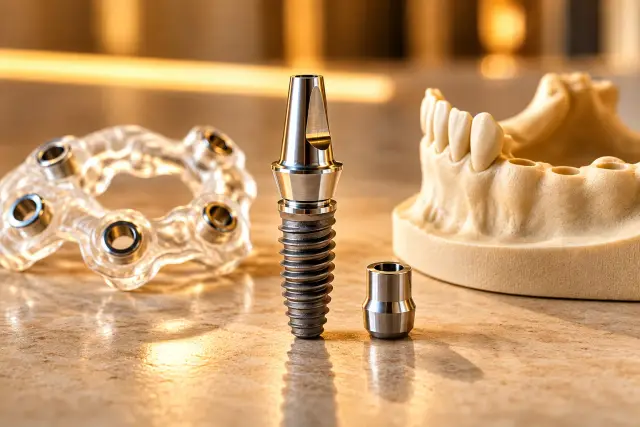
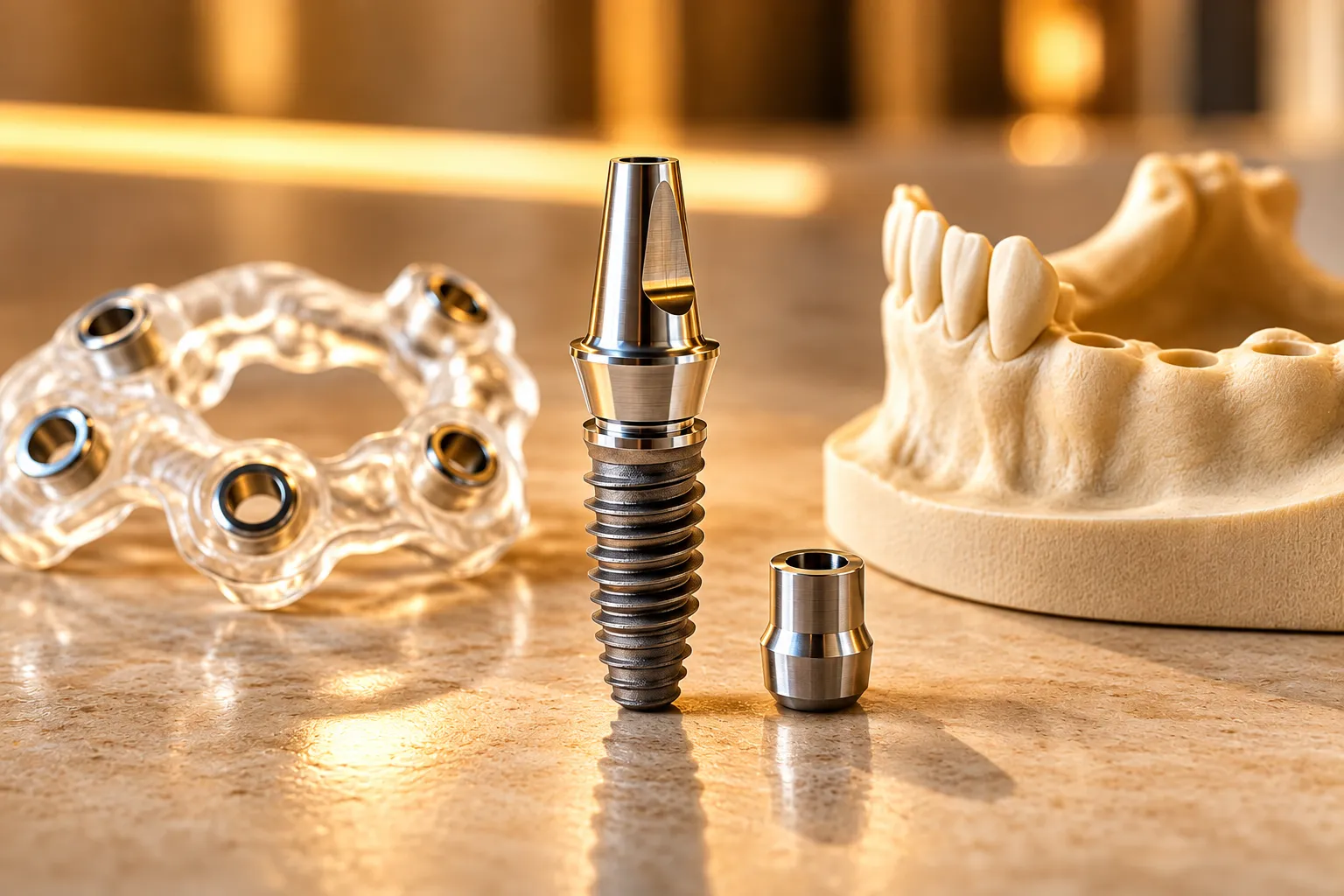
The parts of an implant
Every implant restoration is built from three separate components, which is why a chipped crown does not mean a failed implant.
Implant fixture
The root replacement, placed in the bone and left to integrate. This is the part designed to last a lifetime.
Abutment
The connector that passes through the gum and links the fixture to the restoration. Custom abutments are shaped to support the gum contour around the tooth.
Crown or prosthesis
The visible tooth replacement — a single crown, a bridge, or a full-arch prosthesis. This is the component most likely to need attention over a long enough timeframe.
Who it’s for
- A single missing tooth, or several
- Full-arch tooth loss in one or both jaws
- Failing, fractured, or non-restorable teeth due for removal
- Congenitally absent teeth, commonly upper lateral incisors
- Teeth lost to trauma, decay, or periodontal disease
- Loose or uncomfortable dentures and partial dentures
- Wanting to avoid grinding down healthy teeth for a conventional bridge
What to expect
- 1
Evaluation & planning
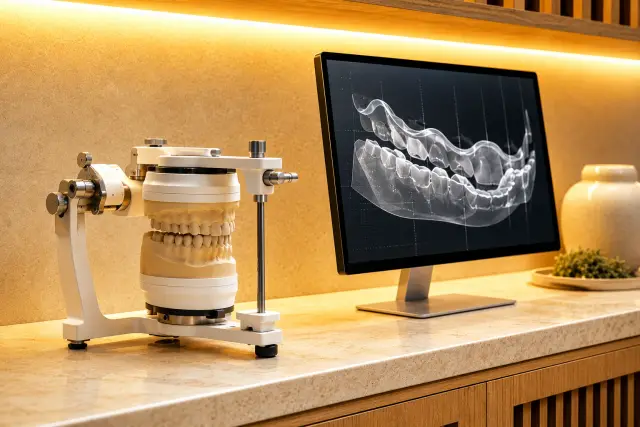
Every case is planned with CBCT imaging, digital scanning, smile design, and bite analysis before any surgery is scheduled.
- 2
Site preparation
Where needed, extractions, socket preservation, or bone grafting come first so the implant is placed into an adequate foundation.
- 3
Implant placement
The implant is placed into the jawbone under local anesthesia, with sedation available. Most patients find it easier than the extraction that preceded it.
- 4
Healing & osseointegration
Over the following months the bone bonds directly to the implant surface, creating a foundation strong enough to carry a bite.
- 5
Uncovering & impressions
The implant is exposed, the gum contour shaped with a healing abutment, and the site scanned for the restoration.
- 6
Restoration
A custom crown, bridge, or full-arch prosthesis completes the tooth in form and function, delivered with your restoring dentist.
- 7
Maintenance
Ongoing professional monitoring of the gum and bone around each implant — the single biggest factor in how long they last.
Recovery & aftercare
Implant placement is performed under local anesthesia and is typically well tolerated. Most patients report soreness rather than pain for a few days, managed with over-the-counter medication, and return to routine activities within a day or two. Swelling, where it occurs, peaks early and settles within a week.
The first week calls for softer food, no smoking, and keeping the site clean without brushing directly over it. Larger surgeries — multiple implants, grafting, full-arch cases — involve more swelling and a longer soft diet, and you’ll be briefed specifically on what to expect for the surgery you’re actually having.
With proper care, dental implants can last decades and often a lifetime. What threatens them isn’t decay — implants can’t decay — but peri-implantitis, inflammation and bone loss around the implant driven by plaque. That’s preventable, which is why maintenance matters as much as the surgery.
Common questions
- Are dental implants painful?
- Placement is performed under local anesthesia, so the procedure itself is painless. Afterward most patients report mild soreness for a few days rather than significant pain — a large proportion say it was easier than having the tooth removed in the first place.
- How long do dental implants last?
- Implants routinely last decades and often for life. The crown or bridge on top is a restoration, and like any restoration it may need repair or replacement over a long enough period. The main risks to the implant itself are peri-implantitis and untreated heavy grinding.
- What is the success rate of dental implants?
- Implants are among the more predictable procedures in dentistry, with high long-term success reported consistently across the literature. The figures fall in patients who smoke, have uncontrolled diabetes, or have a history of periodontal disease — all of which is factored into planning rather than discovered afterward.
- How much do dental implants cost?
- It depends almost entirely on what’s involved beyond the implant itself — whether extractions, socket preservation, bone grafting, or a sinus lift are needed, and what restoration goes on top. That’s why a written plan follows the evaluation rather than preceding it. We set out each stage and its cost before you commit.
- Am I too old for dental implants?
- There’s no upper age limit. Implants are placed successfully in patients well into their eighties and beyond; general health and bone quality matter far more than age. There is a lower limit — the jaw needs to have finished growing, which is usually the late teens or early twenties.
- Can I get implants if I have gum disease?
- Yes, but the gum disease must be treated and stabilized first. Placing implants into an active periodontal infection is asking for peri-implantitis, because the same bacteria that damaged the teeth will attack the tissue around the implants. Treating first and placing second is both safer and more durable.
- Do implants set off airport metal detectors?
- No. The titanium used is non-magnetic and the quantity is far too small to trigger security scanners. Implants are also compatible with MRI scanning.
- Titanium or zirconia — does the material matter?
- Titanium has the longest track record by a wide margin and remains the default. Zirconia is a metal-free ceramic alternative, useful for patients who prefer to avoid metal or where a thin gum might show a gray shadow at a front tooth. Both work; titanium has more long-term data behind it.
- What could make an implant fail?
- Early failure usually means the bone never bonded to the implant — from infection, insufficient stability at placement, or smoking. Late failure is usually peri-implantitis or excessive bite force. Most causes are identifiable in advance, which is what the evaluation is for, and a failed implant can generally be replaced.
Want a second opinion first?
If you’ve been quoted implant, bone-grafting, or sinus-lift treatment and want to be sure it’s the right plan, a specialist second opinion is a low-cost, no-pressure way to confirm your options before you commit.
Request a second opinionTalk to a specialist about dental implants
Whether you’re a patient considering treatment or a dentist referring a case, we’ll evaluate, plan, and coordinate care from diagnosis through follow-up.
Sources
This information is provided for educational purposes and is not a substitute for a professional evaluation. Diagnosis and treatment should always be determined by a qualified dental professional based on your individual condition.